By Liz Frost, frequent visitor and fungi specialist, with Rachel Guy, Kingley Vale NNR Reserve Manager
In mid-December 2025, amateur fungi enthusiast Liz Frost made an extraordinary discovery at Kingley Vale National Nature Reserve in West Sussex — spotting a tiny, tongue-shaped fungus that turned out to be the first ever UK sighting of Microglossum cyanobasis, the Blue-Based Earthtongue, and only the second recorded in Europe.
In this post, Liz shares the story of how she found it, how scientists confirmed the identification through DNA sequencing, and what the discovery tells us about the remarkable ecological value of ancient woodland sites like Kingley Vale. Reserve Manager Rachel Guy also reflects on why National Nature Reserves matter — and why there may still be wonders out there waiting to be found.
I still can't quite believe it. In mid-December 2025, while exploring for fungi in the ancient yew woodland at Kingley Vale National Nature Reserve (NNR) in West Sussex, I stumbled upon something extraordinary – a tiny, tongue-shaped fungus poking up through the moss and leaf litter. Little did I know, I had just made the first ever UK sighting of Microglossum cyanobasis, and only the second recorded in Europe.
What exactly did I find?Microglossum cyanobasis belongs to a fascinating group of fungi commonly called Earthtongues. These little organisms look just like their name suggests – small tongues emerging from the earth. Mine were ochre to pale ochre in colour, measuring between 45-55mm tall with delicate, fragile stems. Here's the really special bit: the base of the stem has a distinctive cyan-bluish tinge. That's actually where its name comes from – 'cyanobasis' meaning blue base. It's this feature that sets it apart from other Earthtongues.
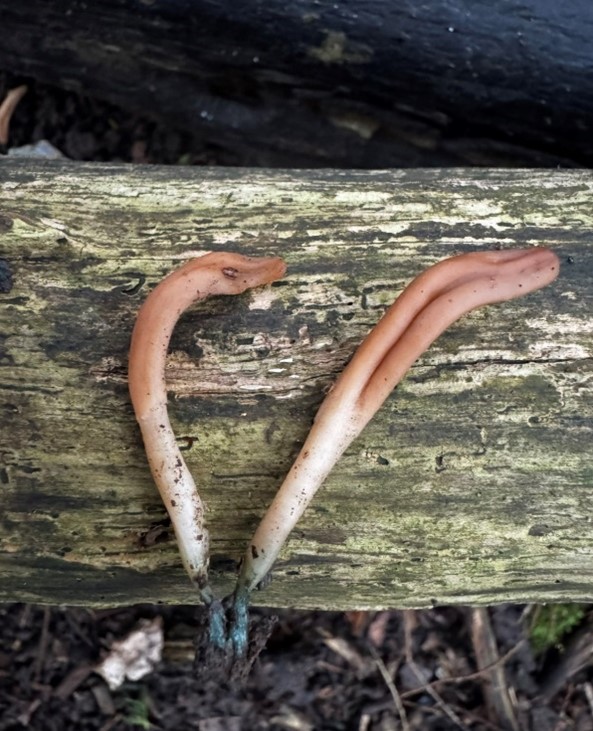
On my first visit, I found six individuals growing closely together amongst yews, oaks and mossy soil. Excitement got the better of me and I returned the very next day, discovering another twelve nearby. They're incredibly easy to miss – small and well camouflaged amongst the woodland floor – which might explain why they've gone unnoticed until now.
Getting confirmation
Finding something unusual is one thing, but confirming what it actually is? That's another matter entirely! I reached out to the British Mycological Society group on Facebook, asking for help. The fungi enthusiast who originally discovered and named this species in Northern Spain back in 2009 suggested it could be Microglossum cyanobasis.
With help from fellow Earthtongue enthusiasts, specimens were analysed under a microscope. The spores and other features matched the findings from Spain perfectly. To be absolutely certain, DNA sequencing was arranged, which confirmed a 99% match. It was official – this was the first UK record!
The joy of looking closer
Earthtongue fungi can act as indicators of high-quality habitats. They're associated with undisturbed, nutrient-poor grasslands and long-established woodland soils – environments that are becoming increasingly rare due to fertilisation, drainage, ploughing and land-use change. Finding them tells us that a site has real ecological value.
I've always loved nature photography, partly for my own mental health and the benefits it brings. Over the past five years, my passion for fungi has grown enormously. There's a euphoric feeling in finding species you've never encountered before – seeing the incredible variety that so often goes unnoticed beneath our feet. They truly are all beautiful in their own way.
I'm still learning. I have books piled at home and spend hours researching online. I certainly can't remember all those Latin names! But that's part of the joy – there's always more to discover, and I get out into the forest whenever I can.
Rachel Guy on Kingley Vale and National Nature Reserves
As the Reserve Manager for Kingley Vale National Nature Reserve (NNR), it was a great day when I heard from Liz about her discovery. As an indicator of high-quality habitats, this find highlights the value of NNRs and the hard work by everyone to look after these special places for nature.
Kingley Vale NNR sits within the South Downs National Park and covers 150 hectares of remarkable landscape. It's home to one of the finest ancient yew forests in Europe – trees that are at least 500 years old and possibly much older. Legend has it they may have been planted to commemorate Viking warriors, or to provide wood for medieval longbows.
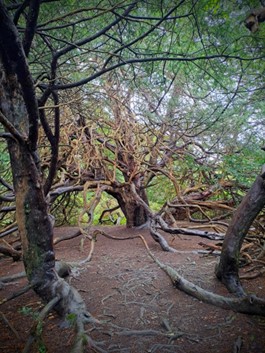
Beyond the ancient yews, you'll find chalk grassland, several species of orchid, butterflies like the chalkhill blue, and breeding turtle doves. NNRs like Kingley Vale offer a first-hand experience of England's special wildlife, safeguarding nationally important species and habitats so they can be enjoyed and studied now and in the future.
We'd like to thank Liz for her enthusiasm and interest in Kingley Vale. We're very excited about this new discovery.
Nature is for everyone, and if you’re interested in volunteering for nature with Natural England, you can find out more in this volunteering on National Nature Reserves video.
Get out and explore
Evidence shows that contact with nature improves health and wellbeing. Whether it's tackling stress, supporting mental health or simply getting fresh air, spending time outdoors does us good.
I hope my discovery inspires you to look a little closer at the natural world around you. Fungi are everywhere – in woodlands, grasslands, even your local park. You don't need to be an expert to appreciate them.
Visit a National Nature Reserve near you. Take a walk through ancient woodland. Who knows? You might just find something nobody has seen before.
Notes: With thanks to Iona Fraser, Placido Iglesias and Malcolm Greaves for their invaluable expertise in confirming this remarkable discovery.
Leave a comment