By Matthew Heard, National Delivery Director, Natural England
Hen Harriers are one of the UK’s rarest birds of prey. However, they are at the centre of a long-running conflict because they prey on red grouse, which are managed for grouse shooting. To help address this problem, Natural England and its partners have explored approaches that could support both Hen Harrier conservation and sustainable grouse shooting. This blog explains the results of the 'brood management' trial, which concluded that this activity contributed to increased numbers of nesting Hen Harriers on some grouse moors, and presents the full evaluation report which has now been published.
Hen Harriers are iconic birds of upland landscapes, yet they remain at the centre of one of England’s most intractable human–wildlife conflicts. Despite being protected by law, they are illegally killed because they are predators of red grouse, and law enforcement alone has not been successful in improving their numbers. Therefore, we have been working with our partners to explore ways of reducing the impact of Hen Harriers on grouse shoots, to support thriving Hen Harrier populations that coexist with sustainable grouse shooting. One method, known as 'brood management', has been trialed in recent years as an avenue to improving tolerance of Hen Harriers on grouse moors.
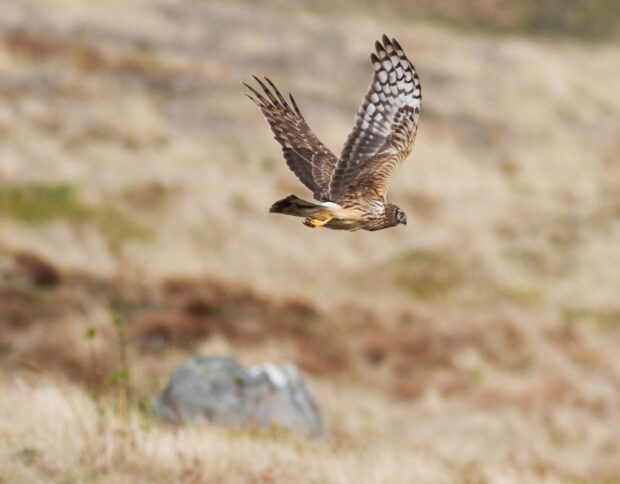
What is Brood Management?
Brood management reduces Hen Harrier nest density on grouse moors by temporarily removing the eggs and/or broods of chicks under licence, rearing them in captivity, and releasing the young birds back into the wild at a suitable location, once they are able to fly and disperse. Providing a lawful way to reduce predation of nesting Hen Harriers on grouse promotes coexistence between grouse moor interests and Hen Harriers.
The Brood Management Trial – recap of the evidence gathered
Brood management was trialed under licence in northern England between 2018 and 2024, through a partnership of Natural England, the Moorland Association, the International Centre for Birds of Prey, the Game & Wildlife Conservation Trust and the Hawk & Owl Trust.
The final reports of the trial have now been published.
Headline results were published in 2025:
- During the trial, Hen Harrier numbers increased substantially in areas managed for grouse shooting where brood management was available (but not in other areas).
- Illegal killing continued throughout the trial, but no crime hotspots were identified within brood management areas.
- Although the act of safely rearing a small number of chicks in captivity probably made a small contribution to population growth, the numbers involved were too low to explain the increase in nesting pairs that took place over this period. Research by the British Trust for Ornithology suggests the increase was more likely driven by higher survival rates and greater settlement and breeding by wild birds.
- At the end of the trial, Natural England and its independent Natural England Science Advisory Committee (NESAC) concluded that the availability of brood management had probably contributed to population growth, primarily through reduced nest disturbance and improved settlement on some grouse moors.
- NESAC advised that the widespread use and awareness of satellite tagging and monitoring as part of the trial likely contributed to reduced disturbance and improved breeding success. Importantly, the effects of the availability of brood management could not be fully separated from those of the accompanying tagging and monitoring programme.
Review of the evidence for brood management
Natural England recognises that brood management is controversial. Concerns include whether brood management addresses the underlying drivers of illegal killing, whether it distracts from the need for effective law enforcement, and whether increases in Hen Harrier numbers are really due to brood management rather than increased monitoring and satellite tagging.
Having carefully considered the available evidence and advice, Natural England's view is that the availability of brood management, including satellite tagging, monitoring and communication of bird locations likely contributed to improved breeding success in some areas.
Current evidence supports use of brood management under licence where projects follow the methods used in the trial. This is likely to include satellite tagging and monitoring, subject to case-by-case assessment. Such projects should be for the explicit aim of increasing Hen Harrier numbers by reducing illegal killing and disturbance.
Not a substitute for tackling wildlife crime
More widely, brood management can be justified as a Hen Harrier conservation tool when used alongside diversionary feeding, engagement, enforcement, monitoring and research. It is not a substitute for directly tackling wildlife crime.
These views are based on the currently available evidence, including the results of the Brood Management Trial, and will be kept under review as new evidence emerges.
Acknowledgements and Further Reading
Natural England would like to thank all the project partners who worked together on making the trial and evaluation possible, as well as the landowners who allowed access for release and monitoring.
- The final reports from the Hen Harrier Brood Management Trial have now been published here.
- Hen Harrier Brood Management Trial Evaluation: The effectiveness of brood management as a mechanism for supporting Hen Harrier recovery. Natural England Research Report NERR153
- Hen Harrier Brood Management Trial: Interim social science evaluation. Natural England Research Report NERR160
- Hen Harrier Brood Management Trial: Findings from the social science survey of moorland managers Authors: National Centre for Social Research. Natural England Commission Report NECR615
Recent Comments