This blog is a summary of Marian Spain and Tony Juniper's appearance in front of the Environmental Audit Committee, and reflections on their time in office.
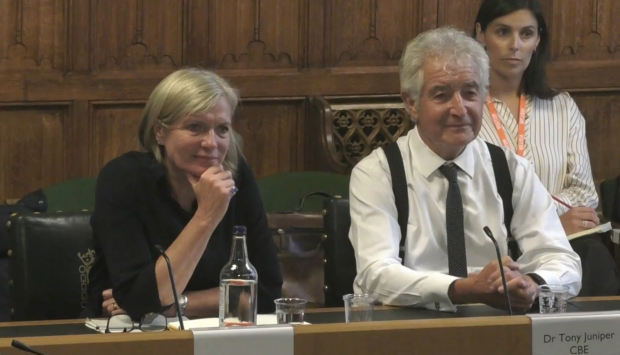
Natural England's Chair Tony Juniper and Chief Executive Marian Spain appeared before Parliament's Environmental Audit Committee this week, reflecting on the organisation's achievements over recent years and making a strong case for why nature must remain at the heart of the country's future.
The special session in the Houses of Parliament gave Marian and Tony the opportunity to look back at their time leading Natural England, while answering questions from MPs on some of the biggest issues facing nature and the organisation today.
Over almost two hours, the discussion ranged widely: from the condition of protected sites and species recovery to planning reform, water quality, climate change, resourcing and the role a healthy natural environment plays in economic growth and national security.
One message ran consistently through the session: nature is not a barrier to the things the country needs to achieve. It is fundamental to achieving them.
Looking back at how far we've come
Tony opened the session by reflecting on the transformation Natural England has undergone since he and Marian began working together in 2019.
He highlighted the development of a much clearer strategic direction for the organisation, increased investment and a renewed confidence in Natural England and its role.
He also pointed to the breadth of work delivered over that period: supporting the development of Environmental Land Management and Landscape Recovery; finding new approaches to enable development while protecting nature; tackling nutrient pollution; expanding National Nature Reserves; recovering species including beavers and white-tailed eagles; connecting more people with nature; and delivering major national trails.
Marian reflected on how this work has culminated in Natural England's current strategy, Recovering Nature for Growth, Health and Security, and the shift it represents in how the organisation talks about its mission.
Nature, she told the Committee, should not be viewed simply as something that needs protecting. Healthy and resilient ecosystems provide essential services on which our economy, health and security depend.
Marian and Tony's message to those who will lead Natural England in the future was clear: keep pushing in that direction, and keep making the case for nature as essential national infrastructure, rather than a "nice to have."
Nature and growth: moving beyond the false choice
A significant part of the discussion focused on economic growth and the persistent suggestion that protecting nature can stand in its way.
Both Marian and Tony strongly challenged that premise.
Marian stressed that Natural England recognises the country needs new homes, clean energy and infrastructure. The organisation's role is not to prevent that development, but to help ensure it happens in the most nature-friendly way possible, protecting the natural systems that the economy itself ultimately depends upon.
Tony described the idea that the country must choose between economic development and nature as a "false choice," pointing to evidence that investment in nature can create economic value and make communities and infrastructure more resilient.
Wetlands, woodlands, healthy coastlines and other natural assets, he argued, need to be thought about in much the same way as other infrastructure: investments that deliver a return for society.
Preparing for a changing climate
Following one of the hottest summers on record, the Committee also explored the impact of climate change and how nature can help the country adapt.
The discussion highlighted the role of green spaces, trees, water and other nature-based solutions in cooling communities, managing flood risk and making places more resilient.
Marian also drew attention to the inequality in access to nature and green space, and how communities with the least access can often be among those most exposed to the impacts of extreme heat.
Programmes such as Nature Towns and Cities demonstrate how investment in greener places can simultaneously support climate resilience, people's wellbeing and local economic growth.
A reflection of the whole organisation
While this session focused on Marian and Tony's leadership, many of the achievements discussed are ultimately the result of the expertise, commitment and hard work of Natural England colleagues across the country.
From people working with farmers and land managers to those advising on planning and infrastructure; from scientists and specialists to colleagues working on species recovery, protected sites, access, green infrastructure and partnerships, the session provided a powerful reminder of the extraordinary breadth of what Natural England does.
Closing the hearing, Committee Chair Toby Perkins MP thanked Marian and Tony not only for their evidence, but for their contribution to Natural England over the past seven years.
As Marian prepares to leave Natural England at the end of September and Tony approaches the end of his term as Chair next year, this session provided an opportunity to reflect on what has been achieved, but also on the scale of the task still ahead.
The central message was perhaps the simplest one of all: recovering nature isn't separate from delivering the future the country needs.
It is one of the foundations on which that future depends.
1 comment
Comment by Miss H J Tyrrell posted on
My thanks, as a member of the general public, are sent to both Marian and Tony. I sincerely hope the recently reformed Labour Government listens, hears and acts on the points made so clearly and wisely to the EAC.