By Matt Heard, National Delivery Director
Hen Harriers are one of the UK’s most distinctive birds of prey and, after decades of decline, have gradually returned to northern England as their population has recovered. Natural England and its partners are working to support this recovery through the Joint Action Plan, helping to balance conservation with wider land management priorities. Annual monitoring shows a long-term positive trend, with efforts focused on tracking breeding success across England. This blog gives the latest figures for 2026.
Numbers of nesting Hen Harriers in England increased in 2026, according to data collected by Natural England, RSPB and partners.
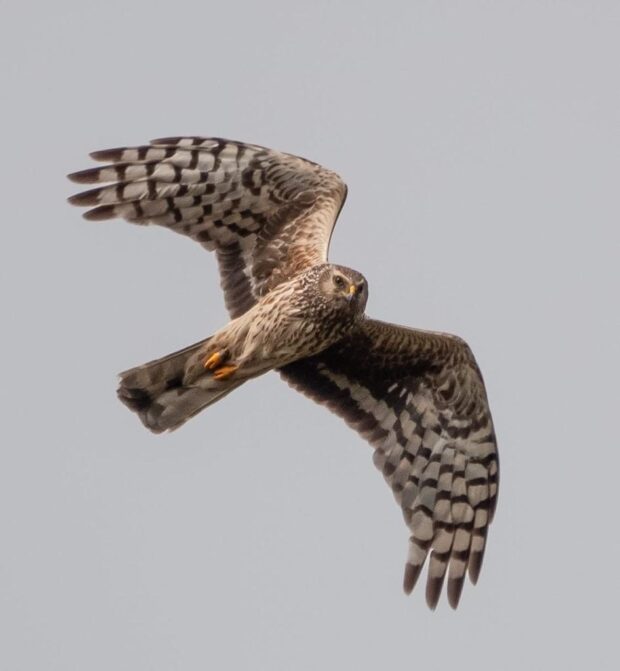
Hen Harriers are a charismatic yet elusive bird of prey species, at home on upland moorland landscapes in the UK. Once reduced to just a few isolated pockets, Hen Harriers have spread from Scotland and returned to the north of England as their numbers have gradually recovered over the past few decades.
Conflicting land management priorities have slowed their recovery, but Natural England and partners have been working to secure their future in England through cooperation under the Joint action plan to increase the English hen harrier population, which was published by Defra in 2016.
Securing a future for the Hen Harrier in England is one of the ways in which Natural England is working to deliver our latest strategy: Recovering Nature for Growth, Health and Security, strengthening the resilience of England's ecosystems and the services they provide through the protection and recovery of key ecosystem components, including species like the Hen Harrier.
Monitoring the recovery of hen harriers in England
As part of the Joint Action Plan, Natural England and partners including the RSPB and raptor monitoring groups collect data on the number of breeding Hen Harriers each year, and, where possible, the number of chicks that successfully fledge each year. It is unlikely that all the breeding Hen Harriers in England are counted, but great effort is made to work with landowners and managers to ensure as many as possible are added to the records to give the best estimate each year. While the data collected by Natural England and partners does not always show an increase on the preceding year, the overall trend of the species' population has shown much growth on a longer timescale, in both number and distribution. Previous annual reporting on the national population, published by Natural England, can be seen here: 2025, 2024, 2023, 2022.
Breeding figures and regional breakdown
In 2026, Natural England, RSPB and partners recorded a total of 45 breeding attempts in England (39 in 2025), of which 33 were successful (33 in 2025), fledging 112 chicks (106 in 2025). This gives an average of 3.4 chicks per successful nest (3.2 in 2025).
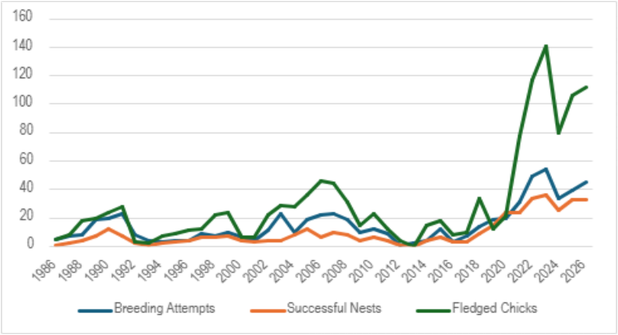
We recorded 1 second breeding attempt in 2026. Therefore, it is estimated that there was a minimum of 44 breeding females in England (39 in 2025).
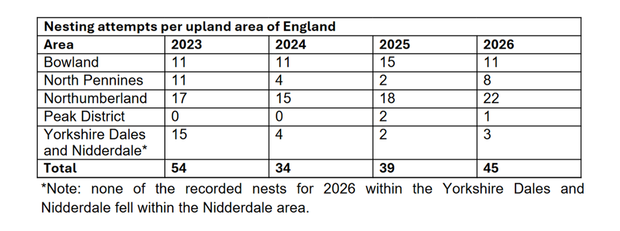
Trends in Hen Harrier numbers
The overall figures show a steady increase in breeding attempts by Hen Harriers over the past 2 years, following a crash in 2024. Anecdotal observations by field staff reported an increase in the availability of prey items (including voles) in 2026, which is likely to have contributed to this increase. However, this was not the case in all areas and a number of factors will also have played an influential role. Annual population fluctuations are to be expected for any species of wild animal, but while the national population remains so small the ability for a population to recover from a decline is significantly reduced. This highlights the need for continued effort to increase the number of Hen Harriers in England and improve their resilience to bounce back from poorer breeding years, which can result from variables such as prey and habitat availability, which may in turn be affected by land management regimes and a changing climate.
This year only 9 of the 45 recorded breeding attempts were made on moors managed for grouse in England, with the remainder across other moorland and water catchment locations (including but not limited to nature reserves). The relatively small number of breeding attempts on grouse moors could be due to the reduced monitoring of grouse moors in 2026 in comparison to previous years. Our monitoring team would welcome the opportunity to work with more moorland owners and agree access and monitoring agreements, with the aim of getting a more complete picture of Hen Harrier numbers.
Working with partners is key
We are grateful for the efforts of our partners to monitor, protect and manage Hen Harrier nests and breeding habitats. We work closely with RSPB staff who record the nesting attempts on RSPB reserves, and on the United Utilities Estate in Bowland. We are also grateful for the contributions of volunteer Raptor Study Groups and Natural England volunteers to nest monitoring, and to landowners and agencies including Forestry England, National Parks, National Landscapes, the National Trust, NatureScot and Natural Resources Wales. Natural England field staff lead on liaison with privately-owned grouse shooting estates, and we extend our gratitude to those land managers who are encouraging Hen Harriers to nest successfully alongside their wider estate management for grouse and other wildlife.
2026 marks 30 years of consolidated data for Hen Harrier breeding activity in England. Natural England is committed to recovering nature, and the Hen Harrier is one example of how long-term dedication can have real meaningful impact for species and landscapes.
We are committed to continue to work with all partners and communities to improve the long-term recovery of Hen Harriers.
Leave a comment