By Tony Juniper, Chair of Natural England
In this blog, our Chair Tony Juniper reflects on a recent site visit to a solar farm in Essex where he saw first-hand how clean solar energy can be delivered alongside measures to support biodiversity and to help nature recover. At Natural England, we give advice to developers to get the best outcomes for nature. This blog explores how the Government’s clean power and nature recovery goals can be delivered together.
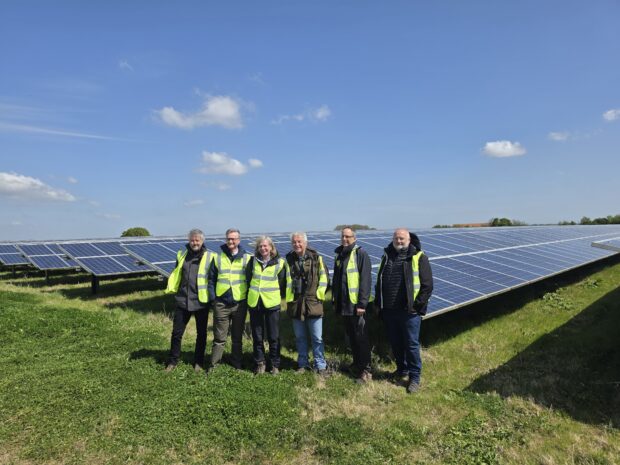
It’s great to see infrastructure projects showcased for their green credentials. And my recent visit to a solar farm was one of these. As we walked through wildflower meadows with Cetti’s Warblers singing from thick hedges, Whitethroats singing and newly arrived Swallows flying overhead, I was impressed by how this site has championed clean power while simultaneously supporting biodiversity.
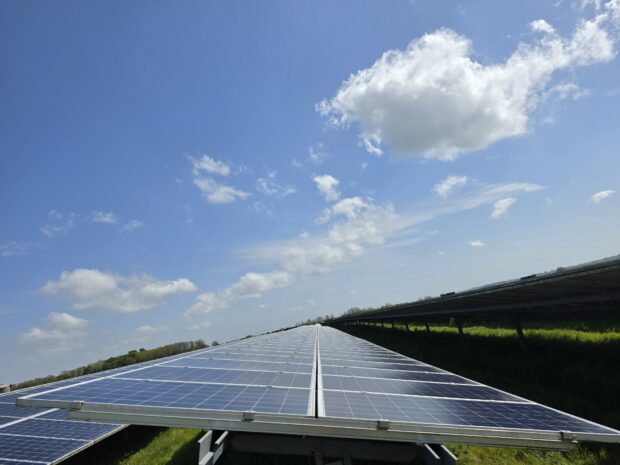
There's a common assumption that clean energy infrastructure comes at a cost to the natural environment. But this is a false choice – solar farms, done well, can actively support Nature recovery alongside energy generation. And that’s exactly what I witnessed at Langenhoe, a site managed by NextEnergy Capital near Colchester, Essex.
The Government recently announced its ambition to roughly triple solar power capacity by 2030, making solar a core pillar of a clean, secure electricity system. This forms part of the Government’s Clean Power 2030 Action Plan which recognises the need to integrate clean power and the natural environment to tackle the climate and Nature crises. Similarly, in Natural England’s new Strategy, we set out how recovering Nature will be a vital pillar to help deliver the infrastructure that the country needs.
Solar farms are now a familiar sight in our landscapes; onshore wind farms are once again starting to come through the planning process, following changes to national planning policy in 2024; and large, offshore wind farms continue to progress through the planning process and into construction.
Risks and opportunities for Nature recovery
As we move towards 2030 and beyond, clean power generation capacity will increase rapidly. Only a few weeks ago, in early April, a new record was set for solar in Great Britain with over 14,000 megawatts (MW) of electricity being generated.
We will see new electricity transmission, distribution and storage infrastructure too. All this development presents risks and opportunities for Nature recovery. At Natural England, we work with developers to get the best outcomes for Nature. Plus, the recently launched Land Use Framework sets out a vision of a more integrated way of managing England’s land. The new Framework shows how Nature, food production, clean energy and housing can complement each other rather than compete.
Natural England’s role
Site selection happens early in a project’s development. At this stage, taking the opportunity to avoid the most sensitive sites will benefit Nature and will also make the planning process smoother. Natural England’s SSSI Impact Risk Zones are a useful tool that developers can make use of to help with this. Environmental records and site surveys will also be valuable. We encourage developers to use our Discretionary Advice Service as they consider their options and progress their designs. Our advice helps to reduce consenting risks and benefits Nature recovery too.
We want to work with developers from the outset to identify environmental impacts so that mitigation measures can be designed into the projects from the start. Where projects are clustered together, there may be cumulative effects. it is important that assessment spots these effects early so that developers and regulatory authorities can join up mitigation at the most efficient scale.
Typical impacts for a solar farm might include impacts on landscape character, agricultural soils, protected species, or areas used by important bird populations for feeding or roosting near to protected sites. Sensitive design and construction methods are needed to mitigate these impacts. In some cases, where not all impacts can be mitigated for, there may be a need for habitat compensation. Biodiversity Net Gain will also need to be planned for.
Environmental enhancements
Solar farms offer great opportunities for environmental enhancements on site. For example, some developers are investigating the potential for re-wetting peat soils beneath solar panels, to help store carbon and mitigate for climate change as well as providing habitat benefits.
Within individual sites, there are opportunities for multiple benefits to be gained from the land. For example, between and beneath solar panels, soils may be protected, wildflower habitats can be managed, and some grazing may be possible. Boundary features such as hedgerows and ditches may be enhanced for nature and to integrate the site into the landscape.
Best practice
It was great to see Langenhoe in action. This solar farm has been operational for over a decade now. It was developed on agricultural land next to the Colne Estuary Special Protection Area, Ramsar and SSSI and close to the Essex Estuaries Special Area of Conservation. The project included mitigation measures for impacts on wintering birds associated with those sites, as well as enhancements including wildflower habitat, scrub planting, bug hotels and hibernacula. In 2025 a pair of corn buntings was recorded inside the solar farm for the first time, feeding in the north‑west wildflower meadow, a significant result for this red‑listed farmland bird.
I was interested to see how the site had matured, what the ecological monitoring had found on site, and to hear the site operator’s perspective on the successes and challenges of managing the solar farm alongside nature.
Hing Kin Lee, Group Lead for Nature from NextEnergy Capital, told me:
“At NextEnergy Capital, we design and manage solar with nature in mind from day one - not as an afterthought. By integrating biodiversity, land management and cost considerations early, we can identify key risks and dependencies upfront, from soil health to habitat connectivity and long-term land use.
“This approach reduces delivery risk, avoids costly late-stage mitigation and ultimately creates more resilient assets. In practice, it enables us to deliver solar farms that not only support climate goals, but also actively contribute to nature recovery while enhancing long-term performance and value.”
Chris Hewett, CEO at Solar Energy UK said:
“Solar farms, managed well, can boost nature and support farming, as well as generating clean, affordable electricity. Solar Energy UK has been working with its members for five years on ecological monitoring, best practice land management and creating major biodiversity gains on solar farms across the country. Independent research from RSPB is now showing significant improvements in bird populations on solar farms compared to surrounding arable land.
“We were delighted to show the Natural England leadership around a solar farm to show what can be done for nature on these sites and look forward to working more closely with the team in the years to come.”
This site, not much over 30ha, is producing enough electricity for seven or eight thousand homes and has led to more biodiversity being present at the site of the solar installation compared with what was there before, with a net gain of 80%. Less than 5% of the land surface is changed to buildings or hardstanding, with most of the ground around the power producing technology and between and beneath the panels capable of supporting wildlife. Looking at this site and it is apparent that the alignment between solar energy and Nature can be strong and good outcomes achieved via inexpensive common sense measures.
At Natural England we believe the benefits for Nature recovery arising from solar power can be significant and we want to work with developers from the earliest stages of project design to get the best for Nature and growth. This project shows what's possible.
The Clean Energy Superpower Mission is one of the government’s five core national missions, led by the Department for Energy Security and Net Zero. Its central commitment is to deliver clean power by 2030 and accelerate the transition to net zero, while cutting bills, strengthening energy security and creating jobs across the UK.
Recent Comments