Karyn Haw, Senior Officer - Nature Recovery Network, East Midlands Area Team
Karyn Haw, Senior Officer in Natural England's East Midlands Area Team, reflects on the recent news that Sherwood Forest's iconic Major Oak has died. Drawing on a career spent working in the forest, she explores what made this ancient tree so remarkable and the pressures that led to its decline. But this is not simply a story of loss, Karyn also looks ahead to the vital role the Major Oak will continue to play as a rare and irreplaceable habitat, and a lasting symbol of our relationship with the natural world.
Last week, I found myself unexpectedly emotional at my desk as news emerged from the Royal Society for the Protection of Birds (RSPB) that the Major Oak has now died. Having spent my entire career working in Sherwood Forest, my connection to its ancient trees is both professional and deeply personal.
These trees are of immense ecological value, but what has always struck me most is the sense of continuity they embody. Ancient oaks like the Major Oak have stood for centuries, quietly witnessing the evolution of the landscape and our relationship with it. They remind us of both the brevity of human timescales and the responsibility we share as temporary custodians of these remarkable ecosystems.
The Major Oak, in particular, holds exceptional significance. Estimated to be over 1,000 years old, it stands at the centre of what was once a royal hunting forest, frequented by English monarchs across the centuries. It is part of the Birklands and Bilhaugh Site of Special Scientific Interest (SSSI) and a Special Area of Conservation (SAC), reflecting its importance at both national and European levels. Ecologically, it has supported an extraordinary diversity of species. Culturally, it has provided a powerful and enduring link between people and nature.
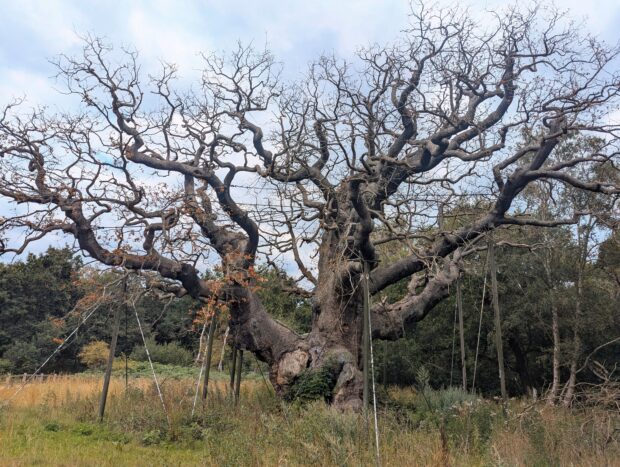
However, the same qualities that made the Major Oak so iconic also contributed to its decline. Its popularity, particularly from the Victorian era onwards, brought increasing visitor pressure. Early access by horse-drawn carriages, followed by motor vehicles and sustained footfall over decades, led to significant soil compaction around its root system. This reduced the availability of water and nutrients essential for its health. More recently, the effects of climate change have exacerbated this stress. Prolonged periods of heat and reduced rain at critical times have been particularly damaging within the naturally free-draining sandy soils of Sherwood.
Over the years, Natural England has worked closely with Nottinghamshire County Council and more recently the RSPB to better understand and support the tree's condition. Scientific monitoring and interventions included root radar mapping, soil microfauna analysis, foliar sampling to understand nutrient uptake, and detailed soil and vegetation surveys. Management actions also included the removal of mulch and competing vegetation. These efforts have significantly advanced our understanding of the tree's physiology and the pressures it faced.
I have been fortunate to experience the Major Oak in many contexts: carrying out bat surveys at dusk as a volunteer, guiding site visits, sharing its story with colleagues and bringing my own family to stand beneath its vast canopy. These moments have reinforced not just its ecological importance, but its unique ability to inspire and connect people.
While this marks a sad moment, it is also an important reminder of ecological resilience and continuity. The death of the Major Oak does not mark the end of its contribution to the forest. On the contrary, it enters a new and equally significant phase. As the central trunk decays, it will create vital habitat for a range of specialised and rare species, including nationally scarce and near-threatened invertebrates such as darkling beetles and flies. Its hollowing structure will continue to provide roosting opportunities for bats, including brown long-eared bats. The processes of decay, fungal colonisation and habitat formation within the tree are integral to the biodiversity value of ancient woodland systems.
In this way, the Major Oak continues to give life. Its later stages support species that have declined across the wider countryside, making it as ecologically important in death as it was in life. Its story is not ending. It is evolving. The way people connect with the Major Oak may change, but its ability to inspire, educate and provide a focal point for shared memories will endure. For generations to come, it will provide a home to some of our most threatened species and remain a powerful symbol of Sherwood Forest's natural heritage and the enduring relationship between people and place.
17 comments
Comment by Deborah Egan posted on
I first stood within it when I was 10.i felt a deep sense of history and hope and connection with thise that had gone before. Of course as a 60's kid had watched Robin Hood riding through the Glen on tele.so that was a thrill being in a place were celluloid became flesh.
Comment by Sarah Oldknow posted on
Thank you
Comment by Monica Cameron. posted on
I remember the Major Oak from childhood, playing on the forest with my cousins in Edwinstowe, in the 1960s. We used to squeeze inside the Major Oak,where it was split & had become worn shiny. We loved it & felt very proud that it was there. It's sad that it has now died but it will live long in the memories of those of us that knew it many years ago.
Comment by Michael Jolliff posted on
If the soil compaction was known about why wasn't something done years before?
Comment by Paul Harvey posted on
Agreed, the public have been prevented from approaching the tree for 40 years, plenty of time to aerate the soil.
Comment by Jean Hopkin posted on
Farewell major oak, but long life to every creature you have spawned, and so you will live on
Comment by Lynda Bolt posted on
I'm 74 and remember playing in and around the Major Oak as a child while visiting my grandparents who lived just 10 mins walk from Sherwood Forest
Comment by Mike Wheeler posted on
I can remember the Major Oak when I was a young boy. My parents brought me to the forest for a picnic on a Sunday and at the time , about 75 years ago, people were able to go inside the tree, I did so myself and sat outside the tree was an old man selling post cards of the tree.
There were no chains or supports on the tree at the time, it was a strong, and full canopy tree. I visited last week and found it so sad to see the Major Oak as it is. As I stood looking at the tree with my wife, it brought back memories of all those years ago.
My wife and I visit the forest most days of the week, we just love to walk through the forest. I just absolutely love trees. The peacefulness of the forest is so calming.
Though the tree is now dead. I will always remember The Great Major Oak of Sherwood Forest.
Mike Wheeler
Comment by James Stubbings posted on
The Major Oak which I knew as Robin Hoods tree as a child and also stood inside it on a school trip which that memory has always stayed with me and I am now in my eighties.
Comment by Diana Bruce posted on
Thank you.
So good to know the Major Oak will remain and contribute still to the life of the forest. At 76 now I have very fond memories of it in my childhood years and have taken children and grandchildren to see it. More visits to come too. Thank you again for everything you and your colleagues continue to do to sustain this wonderful work of nature.
Comment by Catherine Beall posted on
A very moving and honest description of The Major Oak. Rooted in my childhood memories. Everyone who came to stay with us, we would take to see the Major Oak. Have a photo of me, age 12, my mum and Austrian pen friend with The Oak in 1966. A real treasure!
Our Geography teacher taught us how all the oaks in Sherwood Forest were at risk due to farming breaking up the bedrock allowing water to drain away from the roots of our ancient trees.
The recent news broke my heart.
Somehow The Major Oak must be saved for future generations.
Comment by Anna posted on
Does the major oak have any children or grandchildren trees grown from its acorns so the legacy and legend can live on?
Comment by Adrienne Van Den Tooren posted on
I was also five in the fifties when I first went inside it’s trunk and now grieve to think of it dead.
I have wondered if remedial work could not have been done earlier and hope it is guarded in death with many samplings to carry on the line.
Comment by Rita Stead posted on
I feel sad to hear this . I'm 74 now and I remember my brother and I going inside it .
Comment by Robert Stevenson posted on
I was born in Edwinstowe in 1948 a 10 minute walk from the forest, every school holiday and week end was spent in the forest, what a child hood. I hid from my mates inside the tree, I can remember them finding a detonator in the tree from the army manoeuvres across the main road. I went to the church school just on the edge of the forest, our cross country course was from the school yard through the graveyard up the forest, round the Major Oak and back to the school. We still visit now even though I am in Yorkshire, I feel very saddened and like I have lost something of my past, thanks for all the great memories my favourite tree.
Comment by Jennifer Thorp posted on
I fear as bits start to drop off it's going to be difficult to stop people stealing them as souvenirs.
Comment by Shama amazonacongo Saeedforestjungle posted on
Something should have been done to keep this wonderful and beautiful 🌲 tree,I'll always love and cherish it and the connection to robin hood,again Sherwood forest should have been expanded years and years ago,makes me upset and angry as should be looked after it's our history and past present and future.
I'm a tree lover and tree photographer and to hear about this majestic and gorgeous major oak is saddening to the core.
Love you forever,rip.major oak