By Stephanie Bird-Halton, Director - National Delivery at Natural England
The 2025/26 Annual Monitoring Report for Natural England’s District Level Licensing (DLL) for great crested newts has just been published. This blog explores the successes so far and shows that the scheme is creating high quality habitat for great crested newts, while giving developers more certainty and speeding up planning decisions. Through the scheme more than 51,500 new homes and more than 15,000 hectares of developments have been enabled and over 4,747 compensation ponds created or restored. Overall, it proves that development and nature recovery can successfully work hand-in-hand.
In England great crested newts, known for their striking orange and black spotted bellies and the male's wavy crest along his back, are very important in our pond landscape. In the last century, though, there has been a sharp decline in the species mainly due to pond loss and intensive agriculture. Great crested newt populations are estimated to have declined by more than 40% since the start of the 20th century, while around two-thirds of ponds have been lost from our landscapes.
This has led to great crested newts being protected, with environmental regulations put in place to support their long-term future. To enable developers to more efficiently and effectively meet these regulations and to facilitate nature recovery across entire landscapes, District Level Licensing (DLL) for great crested newts was launched.
We have now published the 2025/26 Annual Monitoring Report for Natural England DLL and it demonstrates that the scheme continues to support nature recovery while giving developers greater certainty and helping local planning authorities (LPAs) progress planning applications more quickly.
DLL for great crested newts provides an alternative to the traditional sitebysite approach. Instead of surveying and protecting newts on site, developers can offset the evidence based predicted harm of their development by funding the creation of new ponds in places where newts are most likely to thrive, and the monitoring and maintenance of these for 25 years. General information about the Natural England DLL scheme
The scheme aims to:
- create more high‑quality habitat and support thriving newt populations
- provide a more efficient and cost-effective licensing system for developers
- provide a more efficient and effective licensing system for LPAs
This Annual Monitoring Report sets out the outcomes of Natural England's DLL scheme for 2025 to 2026 and highlights key achievements since launch. Its findings are consistent with the first five-year evaluation report, published in early 2026. For more information on these results read our blog post: The First Five-Year Evaluations of Strategic Licensing for Great Crested Newts.
High‑quality habitat for newts
By 31 July 2026 4,611 compensation ponds had been created or restored through DLL. That’s 967,000 square meters of pond habit, with terrestrial habitat made available to newts by the ponds. The Annual Monitoring Report showed that:
- 4,497 compensation ponds have been delivered since launch of the scheme to 31 March 2026
- this is an increase of 681 ponds delivered since the last Annual Monitoring Report 2024/25
- 75% of ponds surveyed in 2025 were high quality for great crested newts
- the scheme has delivered a net increase of over 1,170 ponds across licensed developments (6 compensation ponds provided for every one occupied pond lost)
- when developments with a signed certificate (those not yet licensed but committed to using the scheme) are included, the projected total net increase is 3,035 ponds
- over 38% of ponds have been used by great crested newts at least once in the last five survey years (an increase since the previous reports)
- there has been a net increase of 571 ponds used by great crested newts (when taking into account ponds used by newts that have been lost to development)
- in just the 2025 survey season, 39% of ponds were used by great crested newts
Great crested newts use networks of ponds and the expectation of DLL is not for all compensation ponds to be used by newts at the same time. Some scheme areas are less than five years old and ponds have fewer than five-years monitoring data. We look forward to seeing outcomes of the scheme as the survey data grows.
Habitat delivery partners recall success
Under DLL, developer compensation includes the monitoring and maintenance of ponds for 25 years by our Habitat Delivery Body partners, including Wildlife Trusts and Farming & Wildlife Advisory Groups (FWAGs). Ponds which are restored under DLL must be completely unsuitable for great crested newts in their current condition, meeting criteria to ensure additional habitat is delivered.
Jilly McNaughton of FWAG East said:
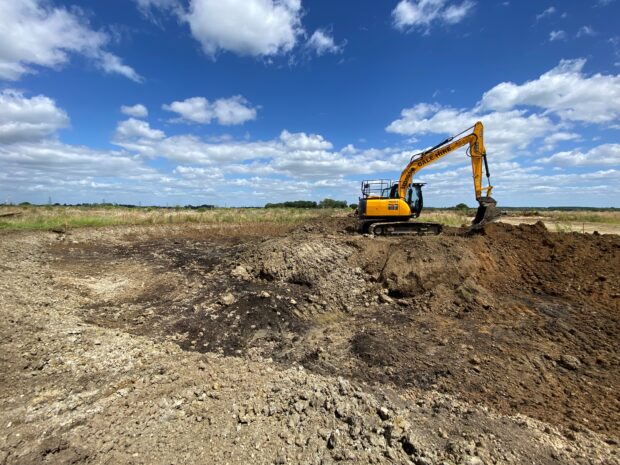
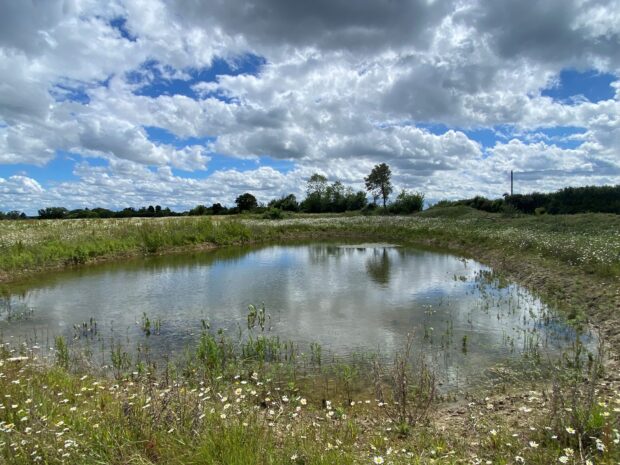
“A highlight of the past year has been watching a ghost pond in Essex bounce back to life. We returned this spring to find a pond reanimated; teaming with invertebrate life and with swallows diving for mud and water.
“At least ten species of aquatic plants had germinated from the old seedbank. Great crested newts have already been recorded in a nearby pond we restored (in autumn 2023) – it’s now only a matter of time until they rediscover the ghost pond we’ve put back for them!”
You can watch a video about the restoration of this ghost pond and the pond revisited this year.
Developer demand for strategic approaches continues
Customer demand for DLL continues, with:
- 1,257 licences issued under Natural England’s DLL since launch to 31 March 2026
- of which 252 licences were issued in 2025/26
- 77% of individual developments that enquire to DLL go onto sign the Impact Assessment and Conservation Payment Certificate (IACPC), demonstrating a commitment to using the scheme.
A successful approach for nature and growth
The Annual Monitoring Report 2025/26 shows that District Level Licensing is working for nature and development. Thousands of new and restored ponds and habitats are providing vital spaces for great crested newts and other wildlife across the landscape.
Leave a comment